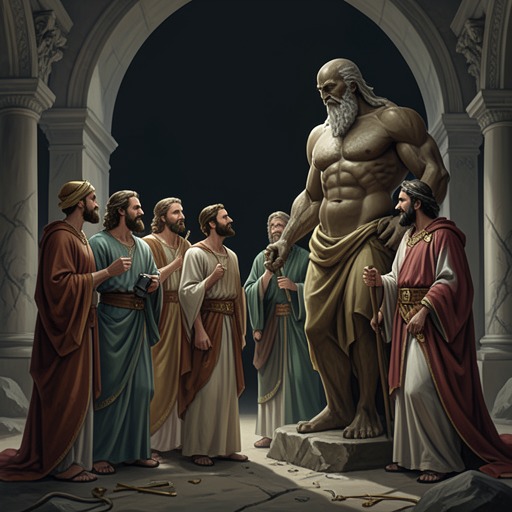
Sulean Liquidation
Systema Delenda EstSulean Liquidation is the emergency planetary liquidation of Sulean, ordered by the System’s highest authority while Meshan is still asserting that the world belongs to him and that its people are under his protection. The order converts political pressure into an extinction timer: Sulean is marked for total extraction, its System connection is to be severed, and Meshan is offered only a one-time essence payment. The crisis forces Meshan to accept Cato’s intervention, making the threatened destruction of Sulean a decisive turning point in the conflict between independent World Deities, the Great Clans, and the System’s hidden central authority.
Causes and Political Background
Meshan enters the crisis as an openly defiant independent World Deity. In the dark wood foyer of his Estate, he confronts representatives of Clan Eln and Clan Lundt, who have arrived under pressure from powers above them and demand that he surrender Sulean or join a united front against Cato. Meshan rejects both the demand and its justification. He insists that Sulean is his planet, that its people are his, and that the Clans have no claim over a world he rules by right and acclaim. His contempt is directed not only at their intervention but at the assumption that distant Core powers can use Cato as a pretext to extend their authority.
The representatives argue that Cato’s threat to the System requires collective action and imply that Meshan’s refusal may indicate an alliance with him. Meshan dismisses Cato as a distant, half-invented monster and treats the accusation as a transparent attempt to frighten him into submission. When the Eln representative repeats the insinuation, Meshan ends the encounter by invoking the essence binding his Estate, Domain, and identity together. The Clan envoys are expelled into the surrounding god-space, and Meshan turns back to the scry windows, preparing to deal with the ultimatum on his own terms.
That confidence collapses almost immediately. The loose coalition of independent gods has formed because the Great Clans are avaricious and overbearing, but its members remain scattered across the System’s worlds and can offer only limited support. Meshan has therefore added new connections to his Estate, including gods who are not close friends, because solidarity is better than isolation. The political dispute over Sulean is still unfolding when the System makes the dispute irrelevant: the world is no longer a bargaining chip but a condemned planetary resource.
The Liquidation Order
Meshan’s Interface announces that the world of Sulean has been assigned for liquidation. The System specifies that all essence and resources will be extracted, that Sulean’s connection to the System will be severed, that Meshan’s connection to the world will be revoked, and that he will receive a one-time essence payment. A timer begins counting down, giving the order the character of an execution rather than a policy discussion. The world’s fate has been converted into a fixed administrative process, and Meshan’s authority over it cannot alter the result.
Meshan tries to use his Interface, Skills, and accumulated authority to oppose the declaration. Nothing works. The order is imposed by a higher authority than a World Deity, identified as the True Core, and the message is not a proposal that can be negotiated or a hostile action that can be resisted by force. It is presented as a fact of reality. Meshan experiences emotions he had long forgotten as he watches the countdown and discovers that his status as Sulean’s Deity gives him no meaningful protection against the institution that created the conditions of his rule.
The liquidation order also changes the meaning of Meshan’s earlier defiance. He had treated the Clan representatives as political opportunists seeking to exploit Cato’s existence, but the Great Clans possess access to a system of authority capable of destroying whole worlds. The threat is therefore larger than Cato’s military campaign. As Mii-Es and Neyar discuss the destruction of planets elsewhere, Neyar recalls only rare prior cases, generally involving worlds that were barely inhabited, and cannot identify the precise cause. Sulean is different because the order falls upon a populated world whose deity is active, connected, and determined to resist.
The Contingency and Cato’s Intervention
Mii-Es has already given Meshan an emergency package, which he had regarded as suspiciously convenient but unnecessary. When the countdown begins, he realizes that she had prepared for precisely the possibility that the Great Clans would use their deeper authority against an independent world. Meshan tells Mii-Es that Sulean has been condemned and that he has just under three hours. She urges him to invoke the contingency rather than seek a direct confrontation through ordinary channels.
The instructions require Meshan to send an unusual contact sequence to his priests. A priest leaves the Temple and speaks the nonsensical string aloud; within less than a minute, a Silver-rank member of Meshan’s species replies with the corresponding passphrase. Meshan repeats it to a memory crystal, which unlocks and begins playing a recorded message from Mii-Es. The contingency is deliberately indirect because the intended contact is Cato, a figure Meshan has distrusted and underestimated.
Mii-Es explains that Cato has already demonstrated the ability to save everyone on Gyvestral and has shown no interest in ruling the worlds he takes. She therefore vouches for him as someone whose goals differ from the System’s political order. She also reveals that Cato can safely extract Bismuth-rank and higher beings even though those ranks ordinarily cannot exist without the System. Meshan must manifest directly on Sulean’s surface, gather the high-rankers, and prepare access to every dungeon core so that Cato’s forces can act before the System destroys the surface.
Meshan fabricates a communicator through his Interface and places it in the inventory of his high priest, who brings Cato’s agent into the Temple. The agent says that Cato’s forces are already present, despite Meshan’s careful search for signs of Cato’s influence and the failure of the Core Worlds to detect them. The service is offered without payment: the disruption is fundamentally Cato’s responsibility, and preserving Sulean will itself be Cato’s victory. The immediate practical question is whether Meshan can open portals to every dungeon core; if he can, Cato can bring down the System there before the countdown reaches its end.
Meshan’s Counterstroke and Immediate Aftermath
Meshan is instructed to bring himself, his Interface, and every Bismuth-rank or higher individual to the surface. The agent estimates that Cato’s operation may take only tens of minutes but recommends allowing at least an hour. Faced with a new and suddenly mortal horizon, Meshan does not simply wait for rescue. He returns to System Space and attacks nearby Clan worlds, exploiting surprise while the liquidation timer continues to run.
The counterattack is not presented as a viable way to save Sulean by itself. Meshan knows that the nearby deities are weak functionaries compared with the powers that forced the order, and that the stronger Clan authorities cannot be defeated through a conventional contest in the few hours available. His purpose is punitive: if the True Core has condemned his world, he will use the remaining time to make the Clans pay in blood. Nearly an hour later, the five nearest worlds are without a Deity, and both Clan Eln and Clan Lundt have lost members.
Before returning to Sulean, Meshan gathers most of his essence and sends it to Mii-Es so that it may support less fortunate independent gods. He then tears open a portal to the surface, where Cato’s agent is still waiting, and announces that the operation can begin. The event therefore ends not with Sulean’s destruction but with a forced alliance: Meshan has preserved his opposition to the Clans while accepting Cato as the only available instrument against the authority that has condemned his world.
Significance in the System Conflict
Sulean Liquidation reveals the System as more than a framework that grants Skills, ranks, temples, and divine authority. It is also an extractive hierarchy able to strip an entire world of essence and resources, erase its connection, revoke its deity, and compensate that deity with a single payment. The language of administration conceals planetary annihilation. What appears as a notification is an extinction mechanism.
The event also sharpens the contrast between different relationships to the System. Muar experiences the temple and its crystal as a return to purpose after the blank terror of System-less existence; Initik remembers the System arriving before agriculture and credits it with ending hunger and nomadic uncertainty; Meshan, by contrast, discovers that the same structure that made him a deity can revoke his world without consultation. Sulean thus exposes the dependency beneath divine sovereignty. A World Deity may guide a people for centuries and still possess only subordinate access to the rules governing their survival.
Cato’s intervention adds a further reversal. He claims that his grievance is against the System rather than its people, and he offers aid not merely to a kingdom or faction but to an entire world, including political enemies. The preservation of Sulean consequently becomes evidence for an alternative order: one in which resources, rescue, and advanced capabilities are used to repair damage rather than extract value from the living. Yet the contingency also shows that Cato’s campaign has generated the crisis. His responsibility for disrupting the existing order is precisely why he accepts responsibility for preventing its consequences.
The liquidation’s threat continues to shape later strategy. Cato recognizes that the highest System authorities may possess administrator-level control over features that ordinary deities cannot understand or resist, including planetary extermination and the granting of additional lives to Azoth opponents. Sulean establishes the practical lesson that a victory over one visible deity or one local authority may remain temporary when the deeper System can rewrite the conditions of the fight. The event’s decisive legacy is therefore both survival and escalation: Sulean becomes a world to be saved, the Great Clans become an existential political threat, and the True Core is exposed as the ultimate source of a reality in which whole civilizations can be liquidated by decree.